
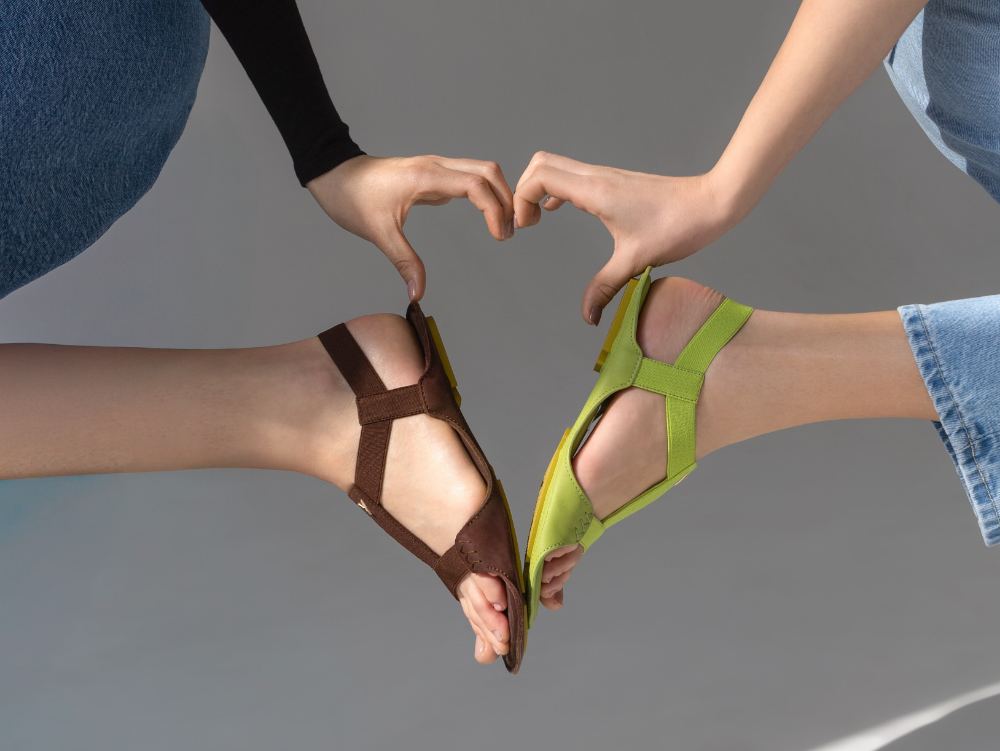
There are thirty of them on the shelf. Three hundred on the screen. They all have a sole, two or three straps and a promise that they’re comfortable, and in the photos they really do look like it. The biggest difference shows up in the first thousand steps: one pair is so comfortable you forget you’re wearing it, while the other rubs and reminds you of itself with every move.
In this guide we share the knowledge we’ve built up over years in the Yonso workshop: how to recognize and choose quality sandals you’ll wear for years. The focus is on recognizing a quality pair of sandals: purpose, comfort, size and craftsmanship, and how to check all of that before you pay. How to choose sandals that suit your style and wardrobe is a topic for another article.
The advice is logical and requires no prior knowledge, and it comes with a few simple tests you can do with your hands in half a minute, so making a good decision is easy once you know what to try. Near the end there’s also a version of those tests for shopping on a screen, because most sandals today are chosen with a thumb, not a foot.
Table of Contents
In short
For anyone who doesn’t have time for the whole guide, here’s a list of the most important things to pay attention to when buying new women’s sandals. Each item is one part of the sandal or one decision, with a short rule on what to look for. If a sandal passes the whole list, you’ll be wearing it for years.
- Purpose before model. City, beach, long walks or a special occasion: each calls for a different sandal, and one pair rarely covers them all. Choose comfortable, flat sandals like Yonso for everyday wear, and save high heels and stilettos for special occasions.
- A comfortable, properly shaped footbed. The footbed carries your entire weight, so a flat, hard board concentrates pressure in the heel and the ball of the foot. Choose a footbed with a heel cup and support under the arch, ideally leather with a layer of memory foam, and before buying press the center with your thumb: if it gives and springs back, the material has memory, and that’s what you’re looking for!
- A sole that bends in the right place. What matters most is that the sole bends in the front third, where your toes do. A completely rigid, hard sole goes back on the shelf!
- Straps that hold without squeezing. The strap keeps your foot in place, and the more you walk, the more that job matters: every millimeter of slipping turns into friction, and friction into a blister. Choose straps that are neither too narrow nor too wide, and smooth on the inside. Adjustable or elastic straps are best (just like the ones Yonso sandals use), because a sandal strap doesn’t break in like a shoe does, while elastic follows your foot even when it swells in the evening.
- Natural leather. Leather breathes, settles to the foot and lasts for several seasons, while synthetics trap sweat in the heat and cause blisters. Choose a pair with the leather pictogram on the label for the upper, lining and sole, and don’t take the word “leather” in a description without a label as proof.
- Size by centimeters. Focus on centimeters instead of the size number! Try shoes on in the evening when your foot is at its largest, and allow 6 to 12 mm of extra room in front of your toes.
- Craftsmanship in five details. Straight stitching, finished edges, invisible glue, a reinforced joint between strap and sole, identical left and right. These are the proof of quality and durability, and exactly the order in which we inspect every pair in the Yonso workshop before it goes into the box.
- Online: same checks, different tools. Pay attention to photos of the sole and the underside of the straps, material labels, size charts in centimeters and the exchange terms before you buy.
- Two pairs for summer are plenty! One neutral (black, cream, beige, brown) that goes with everything, and one in a color that stands out. If you’re buying your first pair, start with the neutral one.
Not every sandal suits every foot
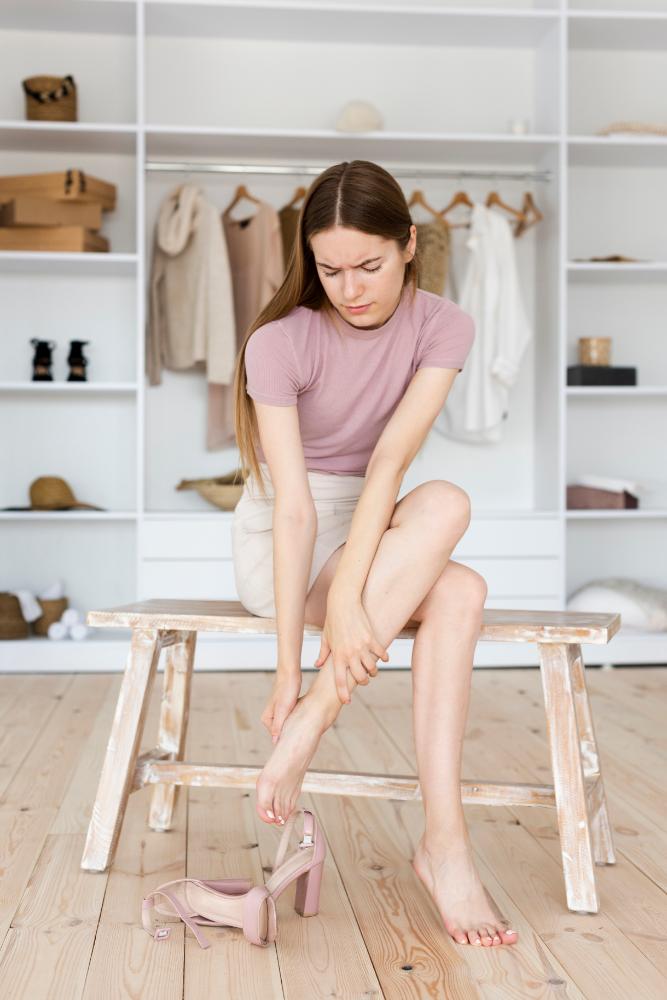
Not every sandal suits every foot, and that’s perfectly fine! Feet are as different as faces: one is wider at the toes, another has a high instep, a third has a heel that won’t tolerate anything behind it. The model you liked in the photo sometimes simply isn’t cut for your foot, and that says nothing about you or about the sandal. It only says you’re not a match yet.
So try on more models than you think you need, and don’t give up after the first pair that doesn’t fit. Everything below in this guide is there to shorten that search: when you know what to look for, you’ll recognize both the pair that isn’t for you and the one that is, faster.
First question: where will you wear them

Before model, color and size, one question: what kind of day awaits you in them? Sandals for an hour at the beach and sandals for eight hours around town are two different pairs of shoes, even if they sit side by side in the catalog. Every sandal has its own strengths and weaknesses, and what you’ll pay most attention to depends on what they’re for:
- City and work. This is where a sandal works hardest: asphalt, stairs and standing in line, so the combination of comfort and elegance matters most. Look for a flat footbed that adapts to your foot and a sole that softens each step, with a line that’s calm and polished enough for the office. We’ve explained how to choose the right sandals for work and the office in a separate article.
- Holidays and the beach. That means sand, salt and water, so rubber sandals and flip-flops dominate here for a reason. If looking good in the sun matters more to you than practicality, choose eye-catching natural leather sandals and take good care of them, because leather remembers salt and water for longer than you’d like.
- Long walks and travel. Here comfort isn’t a luxury, because every shortcoming shows after a few hours. Sandals for long walks need a material your foot can breathe through, a footbed that adapts to your particular foot and a sole that bends with your stride. When those three are in place, the kilometers pass unnoticed. It goes without saying that they should look good too, since they’ll be in every travel photo.
- Special occasions. Stilettos and high heels are a given here, with one rule: a pair that hurts at the fitting will hurt at the wedding too. Flat models remain the right choice when the celebration is on grass, cobblestones or sand, where a stiletto sinks with the first step.
One pair rarely covers everything. Realistically, summer takes two: one pair for days measured in kilometers and one for days measured in photos.
Size and fit: toes and heel inside the edge
A sandal has no toe box to hide a mistake, so the wrong size shows at first glance: a toe over the front edge or a heel over the back. The rule is simple. Your whole foot rests on the footbed, and the edge of your foot follows the edge of the sole, without spilling over the sides. Width matters more here than with a shoe, because a sandal has nothing to hide it with.
With sandals, the size number is less reliable than centimeters. The same size can be a different length at two brands, and with open footwear the extra winter centimeter doesn’t apply, because your foot doesn’t go into a sock. That’s why we’ve explained measuring your foot, reading a chart in centimeters and the rules that apply to sandals in a separate guide on how to choose your shoe size when buying online.
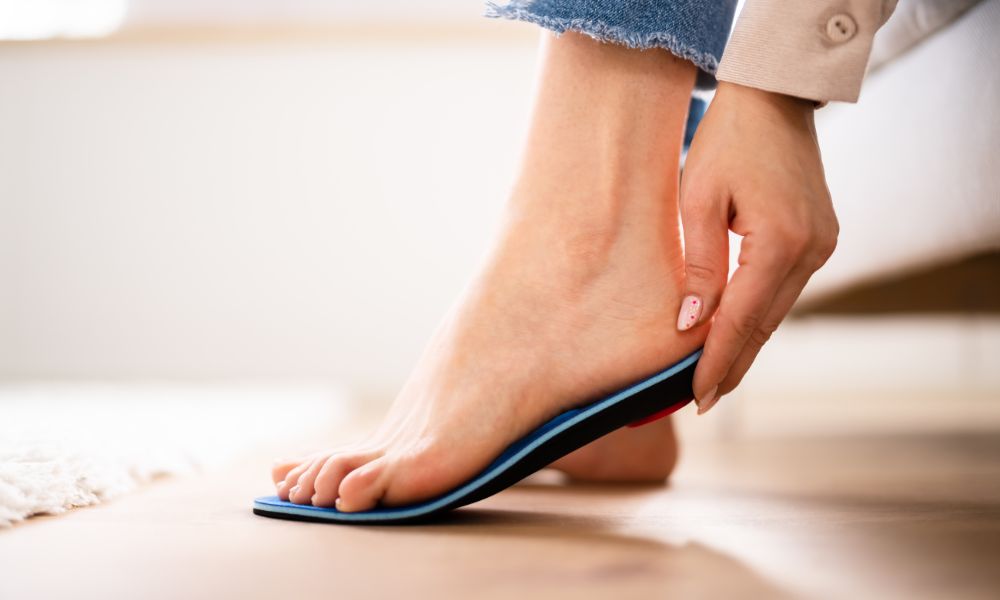
In short, the whole process takes five minutes: foot on paper against a wall, a pencil, a ruler, and do it in the evening, when your foot is at its widest after a full day. Compare the centimeters you measured with the chart of the brand you’re buying from, because every brand measures the footbed slightly differently. With sandals, leave 6 to 12 millimeters in front of your longest toe, and if you’re between two sizes, let the centimeters decide, not how it feels at the fitting.
The sandal part by part: footbed, sole, straps and material
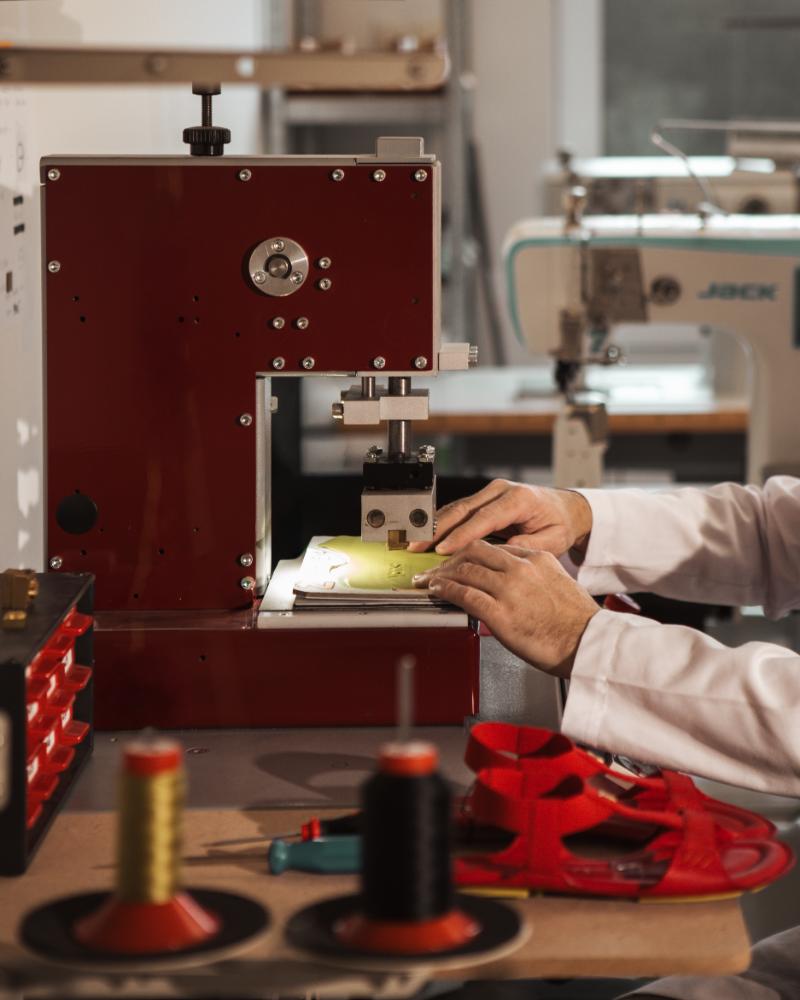
When we pick up a pair in the workshop, we always look at it in the same order: footbed, sole, straps, then leather. Those four parts decide whether a sandal will be comfortable, and the order reflects how much each part affects the foot. The same order works when you’re shopping.
Footbed: where comfort begins
If a sandal’s comfort could be reduced to one part, it would be the footbed. It carries your entire weight all day and is the only thing your foot touches with nothing in between. That’s why, together with the other parts that decide whether a shoe feels good, we’ve devoted a whole article to why comfortable footwear matters, especially in summer. Here are the essentials.
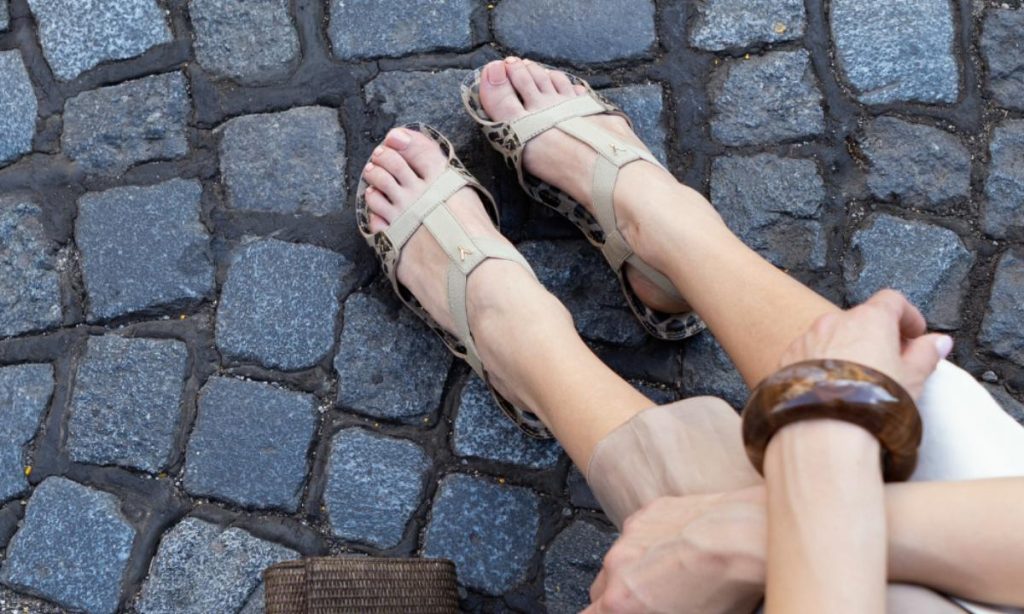
A good footbed follows the shape of the foot. The heel settles into a shallow cup, the arch gets gentle support, and the toes get a flat, wide space to spread out as you step. That way your weight is distributed over the whole surface, so no part of the foot does the work for all the others. On a flat, hard footbed the opposite happens: all the pressure builds up in the heel and the ball of the foot, and those are the soles that ache in the evening even though the pair didn’t rub anywhere.
The material decides how long that shape will last. Leather is the most rewarding here, because it breathes, absorbs moisture and over time remembers your exact footprint, while a layer of memory foam beneath it takes on your shape even after the hundredth wear. A spongy footbed feels nice for the first half hour, then compresses and leaves you on a flat surface. A hard base never compresses, so your foot walks all day on the same board it started on.
Sole: it bends where the foot bends
The sole has two jobs that seem mutually exclusive at first glance: to bend and to be stable. When you step, your foot bends only under the toes, so a good sole gives right there and stays firm under the arch. So along with bending, try twisting: grab the sole at both ends and wring it like a cloth. The middle should resist, because a sole that twists without resistance lets your foot rock left and right as you walk.
Thickness tells you less than it seems. A thin leather sole with a rubber layer cushions your step better than a thick, spongy slab that compresses after a month. Look at the joint with the upper too: stitching along the edge means the pair is made to last; glue peeking out means you’ll need new ones next season.
Straps: what holds the foot in place
A strap has one job: your foot stays still in the sandal, and the sandal goes with you. We’ve already mentioned width and elastic; here are two things that are easiest to overlook at a fitting.
The first is position. A strap that crosses the instep bone or sits right behind the toes presses on spots where the skin has nothing to cushion it, so that’s where blisters form first. The second is the heel: a sandal with nothing around the heel makes your toes clench to hold it on with every step, while a heel strap takes that job off your foot. Before buying, turn the strap over and look at the underside, because the side against your skin should be smooth, without sharp seams or rough edges. What squeezes at the fitting will squeeze all season.
Material: leather or synthetic
In summer it’s skin on leather, with no sock in between, so the material matters more than in winter. Natural leather breathes, absorbs and releases moisture, softens and settles to the foot, and after a few seasons looks better than on day one. Synthetics do the opposite in the heat: they trap warmth, sweat stays between your skin and the strap, and friction turns into a blister.
In your hand, genuine leather is recognized by its irregular pore pattern, its warmth to the touch and its fine, uneven creases when bent. The surest proof is still the label: the leather pictogram for the upper, lining and sole. You’ll find the whole process, along with the myths you shouldn’t believe, in our article on how to recognize genuine leather before you pay.
How to recognize quality sandals
Once the material and shape are right, what’s left is the craftsmanship. Five details, in order:
- Stitching. Even, dense, with no loose thread sticking out.
- Edges. Finished, painted or rounded. An edge that’s peeling in the shop will keep peeling afterwards.
- Glue. Invisible. Every trace of glue at the sole joint is a clock ticking toward goodbye.
- Strap-to-sole joints. Reinforced, because that’s exactly where every step pulls.
- The pair. Left and right identical: same height, same color, same strap position.
With Yonso sandals, each of these five details has its own stage in the workshop: the leather is cut by hand to the pattern, the edges are finished by hand and machine, the stitching is done by hand, and every pair is inspected before it goes into the box. Our sandals aren’t made fast, because quality is never in a hurry.
Tips for buying sandals online: same tests, different tools
You can’t bend a sole through a screen, but you can look for the same answers another way.
- Footbed and sole: look for a photo of the sole from below and from the side. A sole with stitching along the edge or visible layers has already answered you.
- Straps: a photo of the inside, or the words “adjustable” and “elastic” in the description. If the description says nothing, ask.
- Material: the description must separate the upper, lining and sole. “Leather” without a label means nothing; “100% natural leather” with a pictogram means everything.
- Size: a chart in centimeters, not just a size number, and your foot measured in the evening.
- Exchanges: check the terms before you buy, not after. Yonso offers size or model exchanges within 14 days for an unworn pair, and delivery within Serbia is free, so trying them on at home costs only a little patience.
Are flat sandals bad for your feet?
If you’ve ever looked for advice on summer footwear, you know the answer that keeps coming up: flat sandals are to blame for aching arches, cracked heels and tired knees. Podiatrists, however, make a distinction: in their view, flat sandals are perfectly fine for the beach, the garden and the house, and the problem arises when a thin, flat pair becomes your all-day footwear.
It’s worth reading exactly what they criticize: a thin sole that doesn’t cushion the step, a flat, shapeless board, and nothing around the heel. Flat and thin are two different things. A flat sandal with no heel can pass every test in this guide, provided it has what a flat board lacks: a shaped footbed, a sole that bends in the right place and a strap that holds the heel.
That’s how Yonso sandals are made, too. The footbed is leather with a layer of memory foam underneath, so it takes the shape of your foot instead of imposing its own. The sole is natural leather and rubber, with flexible segments stitched between two layers of leather, so it bends exactly where your foot does and stays stable in the middle. The straps are elastic, so they hold the heel just as well in the morning as in the evening, when your foot is half a size fuller. A flat sandal can be the most comfortable pair in your wardrobe, if someone thought about all of this before stitching it.
Style: color and occasion
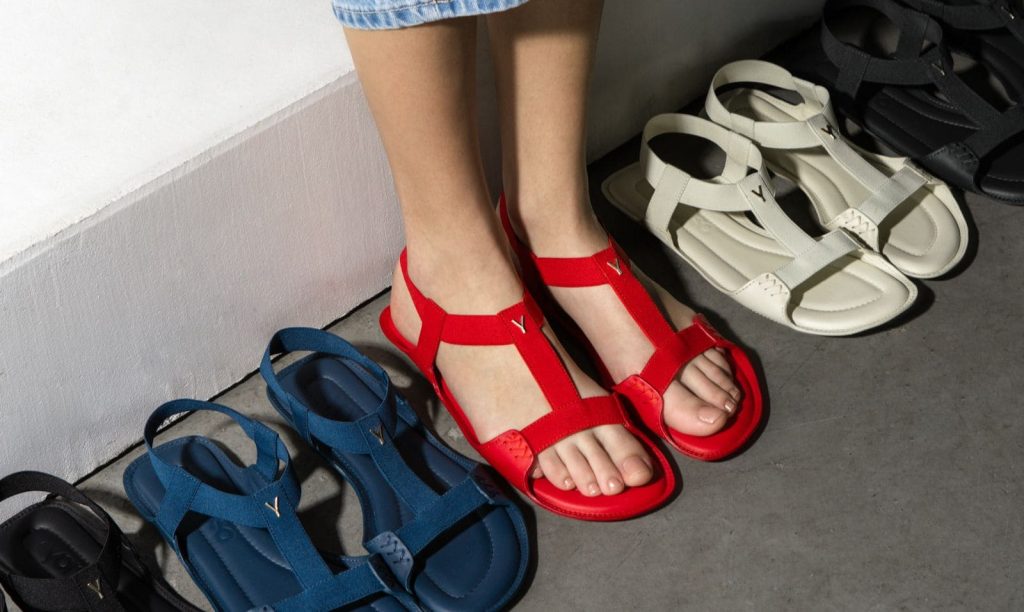
Once all the tests are passed, the most fun part remains. Two pairs are enough for a whole summer wardrobe: one neutral (black, cream, beige, brown) that goes with everything, and one in color (red, green, burgundy) to wear when your outfit is quiet. If you’re still deciding which sandals to buy first, the neutral pair is the answer, and the whole system, with rules on which color goes with which, is set out in our article on combining clothing and footwear colors.
The occasion chooses the line: for work, a flat sandal with a calm, single-color design; for holidays, something freer; for special occasions, a thinner strap. And one trick for the mirror: an open heel lengthens the foot, while crossed straps make it look narrower.
Now you know what to look for
The whole guide comes down to one habit: pick the sandal up in your hands before you put it on. A footbed that follows the foot, a sole that bends in the right place, straps that hold without squeezing and leather that breathes. For the first few days, wear them around the house until you get to know each other, and after that, the only thing between you and next summer is a little leather footwear care.
We make Yonso sandals by exactly that list, by hand and pair by pair, so we’re confident they pass every test in this article. If your search has begun, the women’s sandals in our collection are waiting for you in whichever color you choose. You pick the pair, and we’ll make sure you love it the moment you put it on.